Since the last update to ChatGPT voice, I’ve been enjoying talking to it while driving, and since I have a daily commute of about 30 minutes, I’ve been talking with it a lot. It’s great to bounce ideas, get philosophical, learn new things, and revise your career and life.˝
Last week I had an interesting conversation about my career and how it all happened “perfectly” in alignment to get me in the great place I’m in today; however, we also explored how much my way of thinking, ambition, and my career even switched after I left Siemens, a company for which I worked for 13 years.
I spent a third of my life there. Sure, I learned and grew a lot there, mainly influenced by a few outstanding individuals who shaped my career in their early years, but looking back, I remember the times I felt like I was never going to leave, not because I couldn’t, but rather because why would I?
That kind of thinking kept me in the same place for many years, and the idea of leaving a known, comfortable place was terrifying. And I probably wouldn’t have left if not for other life-changing circumstances that happened and kinda forced me to part ways.
The same situation happened in 2022. I was working as an engineer for ZEISS, working with great people; my opinions and technical expertise were highly respected, and it was honestly a great place to work. At the same time, we had just had our second child, and I was writing for my personal blog, which peaked at over 150k views/month.
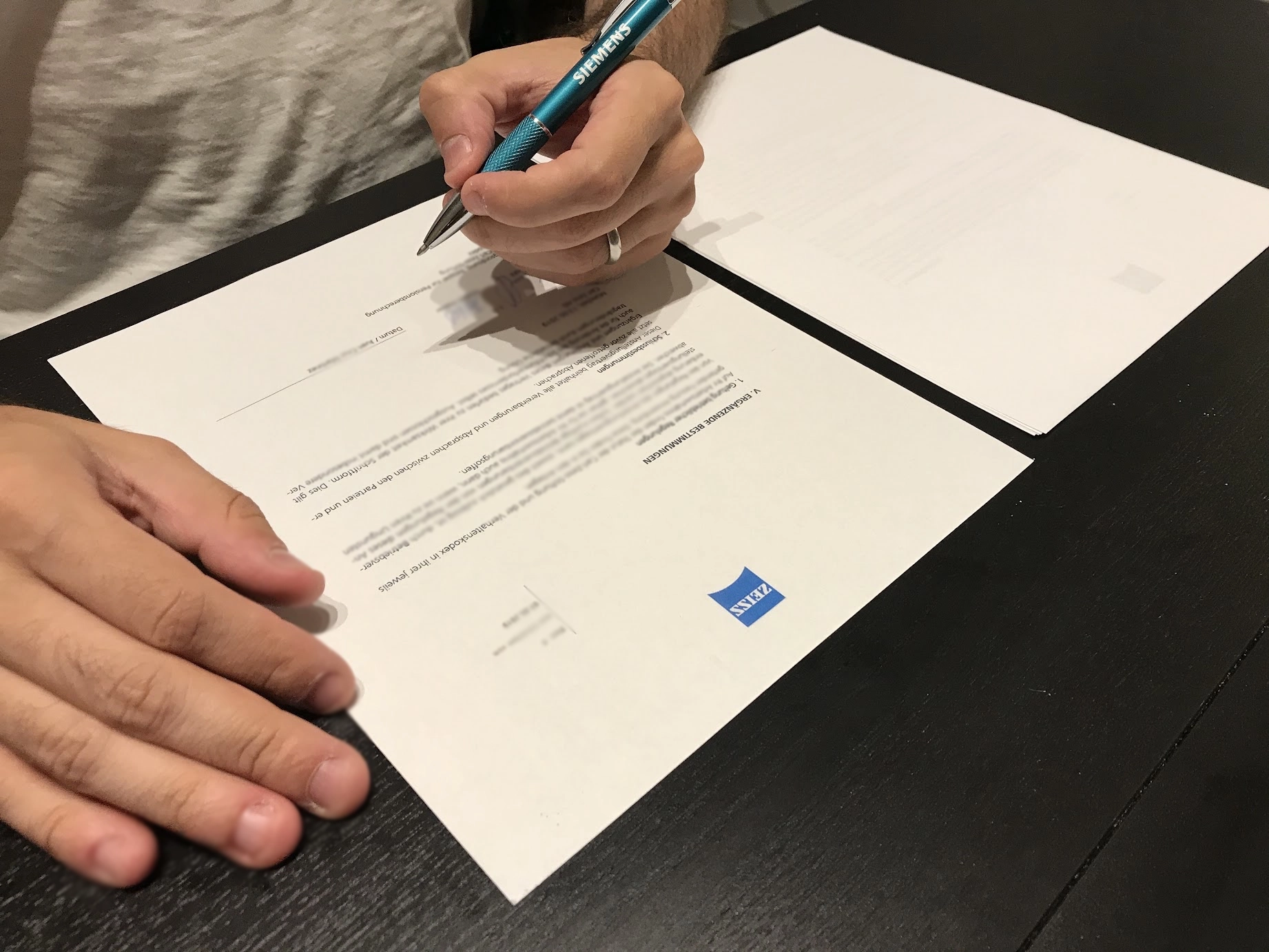
The work on my blog brought me the opportunity to join Okta as a Staff Developer Advocate, and it was a great opportunity for higher pay, working in an exciting field at a big tech company, and representing Auth0, which is an Argentinian product. But with all that going for it, I was scared, and I thought about not signing the contract multiple times because I was afraid of leaving engineering, leaving a team I was happy working with, and changing.
I eventually signed the contract, joined Okta, and promised myself I’d never let fear win; in those opportunities, going out of my comfort zone really paid off. I’m really happy I made those decisions against those primal instincts.
(I don’t have a picture of me signing to join Okta; everything was digital)
Now, not all the time I took risks worked perfectly like these instances, but I’m glad I took those risks, like starting companies, building projects, all from which I learn a lot; some of them are somewhat successful, and some of them are stories for another day.
I’ve seen many people freeze over the idea of change many times, and I get it- been there myself- and often we think about what could happen if we do change, but rarely do we think about the cost of staying.
Complacency kills your career
It is so weird that we developers are creatures of adventure and challenges, always kinda pushing into a tech zone of discomfort, and yet when it comes to our careers, we do the same job for years and are too shy or afraid to step out. And I know not every developer is like that, but it’s a common trend, and it’s pretty normal. So you have to use your brain to fight what’s basically an innate human instinct. It’s uncomfortable, but it’s a muscle you can train.
Complacency is not entirely a human phenomenon. For example, ducks normally migrate in winter because winter removes the resources they need; food and water become a lot harder to find. But when humans change the equation and keep providing those resources, some ducks will stay and avoid what they were supposed to do: migrate.
People can be the same; sometimes comfort gives us enough reason not to move, even when moving would help us grow.
But sometimes being comfortable is not a bad thing, right? After all, if you are happy in one place, why would you move? It would be unreasonable to force change. Unfortunately, many love stories end with a broken heart, and where you are happy today may not be where you are tomorrow. And that happened to me; I was very happy at Siemens at first, until I wasn’t.
The problem with complacency is that it grows over time in two ways. First, what we’ve already been discussing: the longer you are in one place, the more comfortable you are, and the more likely you are to overthink the dangers of moving on. Second, there’s another factor: reputational damage.
When someone stays so long in the same place, with the same position, people will associate that with a lack of initiative and ambition, and that’s not a good thing when you’re looking for something else. Your resume may look shallow after so many years of experience, lacking significant promotions or significant achievements to speak of. Those are definitely red flags, and they make a difference, especially now that we are in an employer’s market, and there are just so many good candidates you’ll have to stand out against for any good position.
At Siemens, I grew a lot, but it was hard to prove on my CV. Fortunately for me, I’ve always been a builder; I’ve always been proactive, and when the time came, I had a big portfolio of projects to show for it. That made a difference for me, and you? Would you have something to show for when the time comes?
Loyalty is a two-way street
A lot of the time, we employees develop a sense of loyalty toward our employers because they pay our salaries, and in a way we feel like they protect us. And that may be true for a while.
When things are going well, and we’re delivering, it’s a great relationship, but companies are not your friends or your family. You get paid your salary, and in exchange you do your job.
You can still do a great job and care about the company, the project, and the people around you. It’s absolutely ok to go the extra mile; I certainly do.
But if that’s what you decide to do, do it for yourself too. Do it because you want to become better at your craft, because you want to build something meaningful, because you want to create a reputation for yourself, or do it for your own sense of accomplishment.
Don’t give your life away because you think you owe the company something.
For a while, things can go well, but when things are getting hard because the markets change, the company changes, the team reorganizes, or anything else, believe me, the company will make the decision that is best for the company, even if that means you’re on the losing side.
Like companies will make those decisions for their own interest, you’d be able to do the same for yourself.
This doesn’t mean loyalty is not valuable, so you shouldn’t necessarily be switching jobs every six months. Staying long enough to see the consequences of your decisions, build deep expertise, and develop meaningful relationships is incredibly valuable.
But loyalty should never become dependence.
Making yourself dependable is a trap on its own
Another weird behavior tends to appear when someone has been in the same place for a long time and starts getting too comfortable. Instead of preparing themselves to move on eventually, they start doing almost the opposite; they make themselves indispensable.
I know I’ve been there, in a position where I was pretty much the only one that could fix a few of the modules we had, as I wrote the whole thing, was extremely complex, my code was efficient, but hard to understand, and I felt important because of that.
During all those years, I developed a false sense of security; it even made me cocky. I was doing what I wanted, arriving late, defying authority, all because I thought no one could touch me.
But it was only after I started helping others understand my code, coaching them into the modules and apps I’ve built over the years, that I started growing in my own position. The more I did that, the more support I got from upper management, and eventually, I was able to move into an internal position, moving countries, into a fantastic opportunity in the USA.
That experience changed how I think about being dependable and taught me a hard-earned lesson. Being dependable means people can trust you, and that builds the reputation you need to progress. On the other hand, being indispensable means the system can’t operate without you, a fallacy that turns you into a single point of failure and will get you stuck.
Being indispensable can make you feel “powerful”, as the organization often relies on you, but it’s a double edge sword, that’s not good for the organization, but more importantly, it’s not good for your career.
Experienced leaders and engineers should pave the path so they can move forward: documenting what they know, simplifying things so everyone can understand them, coaching others, and building systems that don’t require you to be involved in every decision.
I heard these arguments before, in my own head; remember that the goal is to make your current responsibilities transferable while your judgment, influence, and ability to solve new problems keep growing. It is never is to make yourself unnecessary.
Making yourself movable doesn’t mean you have to leave; it just means you finally have a choice.
How do you know when it’s time for a change?
You know it’s time for a change when things are bad. When you hate going to work every morning, when you lose respect for your peers, when your health is suffering. You don’t really want anyone to tell you when you’ve reached your point.
But ideally, you don’t need to be there, and there are some signs you can look into even when you still feel good at the job.
I’m gonna show you a decision matrix I’ve used in the past to evaluate my choices, but please don’t take this as universal truth; use it as a guide to make your own analysis and decide for yourself if it’s time to move on.
Also, when doing the evaluation, don’t focus only on a bad week you’re having, or, on the other hand, an exciting conversation with a recruiter, or a flattering performance review. Look at least at what happened during the last year or two.
I like to evaluate the following areas, and I color-code each row based on how I feel about it during the evaluation period.
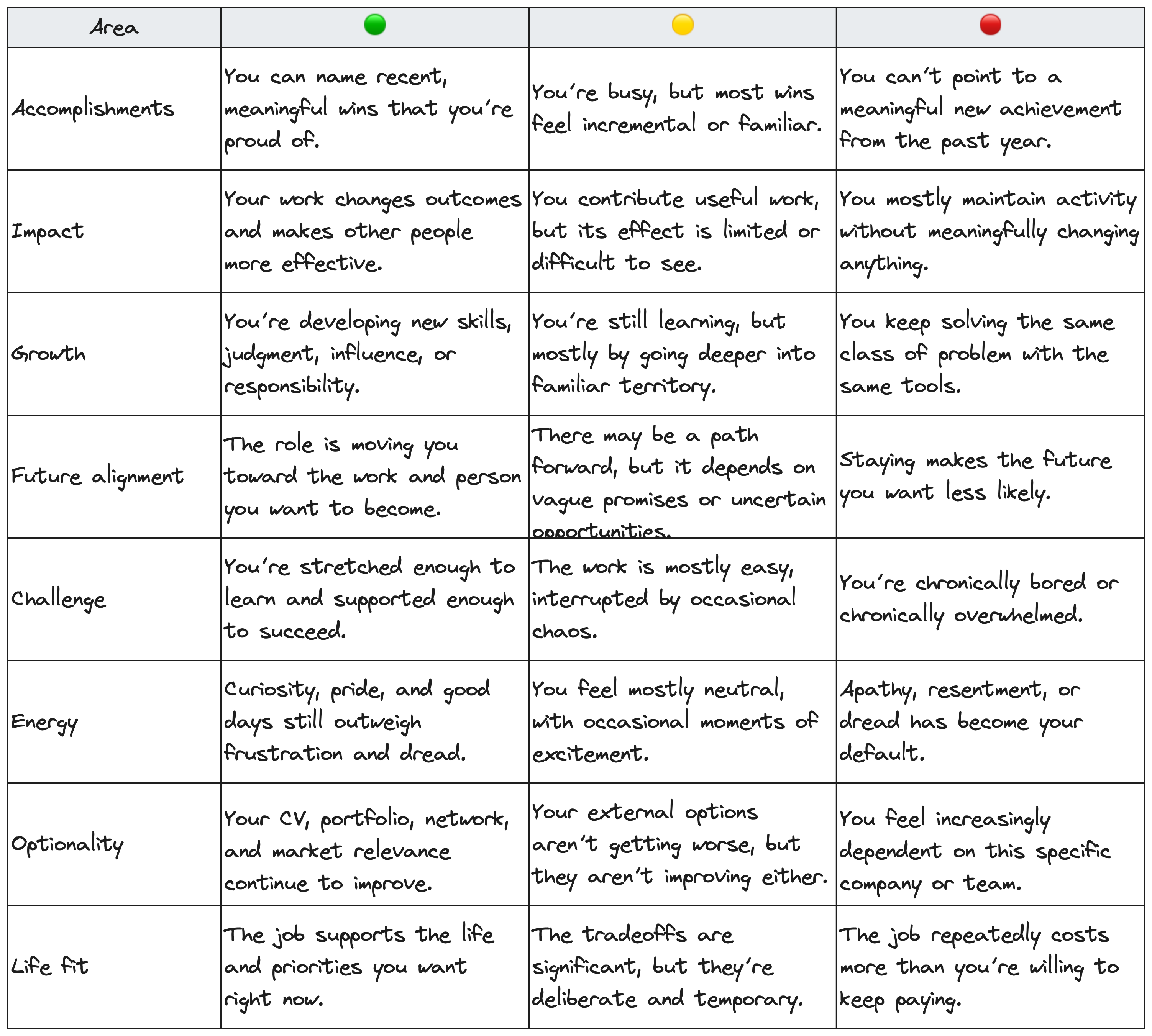
At the end, look at the patterns: are the green rows in the areas that matter the most to you? Do you see any reds that shouldn’t be there?
This isn’t exact science, but doing the exercise critically and visually seeing the colors can help you step back and look at the big picture of where you feel you’re at and where you can go next.
You redo this exercise quarterly, and I keep track of it, so I can also compare its evolution. Mine looks like this:
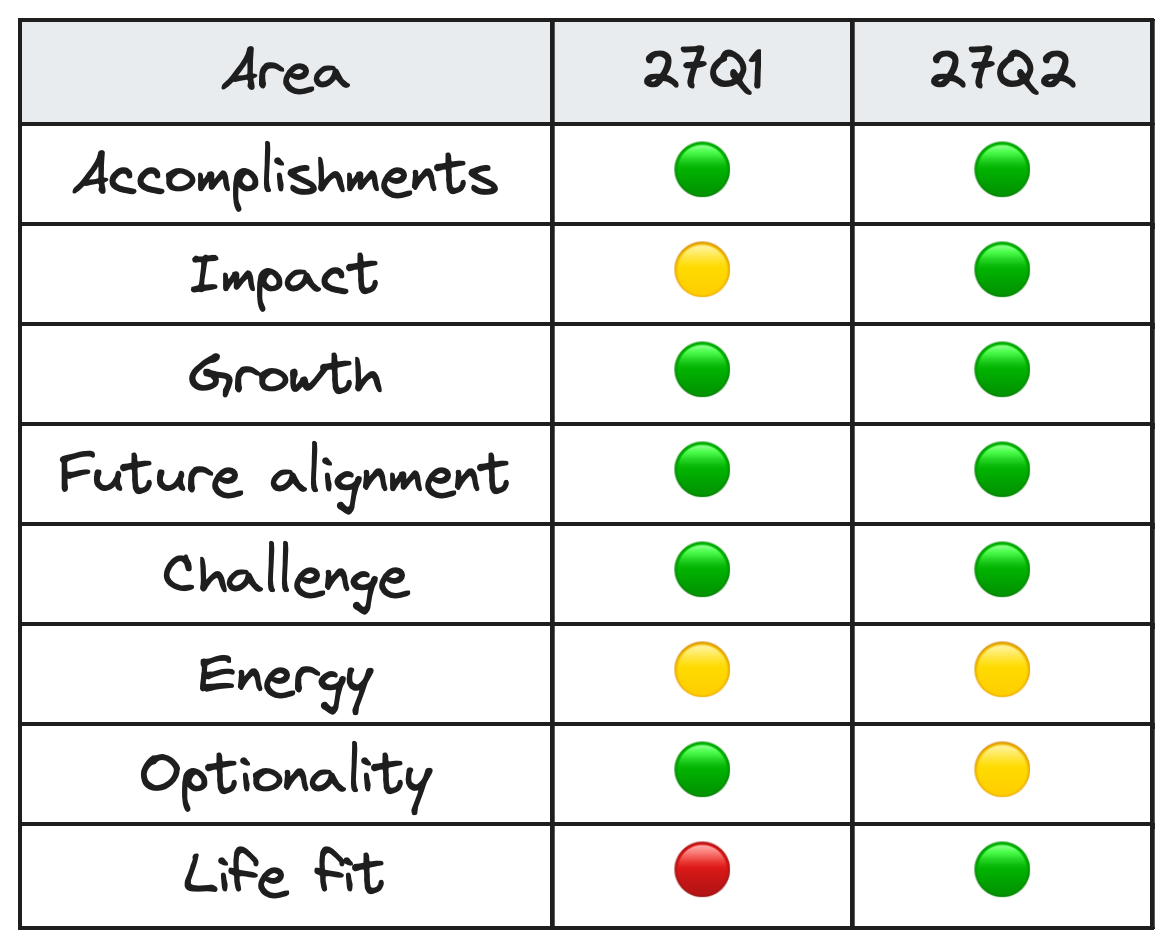
If many areas were red, especially alongside the things I care about, like growth, alignment, energy, life fit, and optionality, I’d probably start thinking about my I don’ts before the situation starts to feel bad.
Change doesn’t always mean quitting
During my many years at Siemens, I worked for different teams, and I had situations where I should have left, and I didn’t, but other moments were different; they were bad, but I didn’t have to leave the company to get it fixed.
Sometimes you need a different team or project. Sometimes you get bored maintaining the same system, or you need more scope, less scope, a different manager, or sometimes it just means having a difficult conversation to help things out.
The first step is to acknowledge that something needs to change; if you are there, fantastic! But don’t rush to quit your job. Start with something smaller first, something that actually addresses the problem.
Now that you are taking action, don’t confuse that action with change.
A new project won’t fix a role without a future, or won’t change anything if you really don’t like what you’re doing. A promise of change in a year shouldn’t keep you waiting forever.
Ask for what you need to change, and set a deadline.
But be clear about what you’re asking for; if you need a new challenge, define what that looks like. If you want more responsibilities, make that ambition explicit. Have the conversation with your manager, and end with clear expectations for what will happen and by when. Agree on any checkpoints along the way so you can re-evaluate.
After that meeting, pay attention to what changes and write them down. Don’t just look at the promises; look at what actually gets delivered and how it matches the set expectations.
If the meeting doesn’t go well, or the situation after it doesn’t change, then quitting may be your best option. You don’t need to do it right away, but you should start exploring your options, interviewing, and looking for new possibilities.
So if things aren’t right, it may be time to move on!