

Most AI apps started from a reasonable fear. Models were unpredictable, prompts were fragile, and nobody wanted production behavior living inside a magic paragraph. So we did what engineers usually do when a system feels unsafe: we wrapped it in code.
We built chains, graphs, routers, callback handlers, retrievers, memory abstractions, evaluation layers, and handoff nodes. Some of that was necessary. If an AI system moves money, changes permissions, updates customer data, deploys software, or touches production infrastructure, the hard boundaries belong in code. Nobody should trust a paragraph in a Markdown file to enforce access control.
But we took that instinct too far. A lot of AI application behavior is not a hard boundary. It is procedure, policy, tone, source discipline, review expectations, escalation rules, examples, and handoff shape. Those are the parts of a workflow that change often, depend on domain judgment, and are usually maintained by people who should not have to modify orchestration code to make the product behave better.
That is the mistake I think the first wave of AI apps made: we treated too much of the AI layer as an orchestration problem. The future is simpler than that. Code should provide the harness. Markdown should carry much more of the work.
That is what I mean when I say Markdown is becoming the application layer of AI apps. I do not mean Markdown replaces Python, TypeScript, Go, SQL, permissions, tests, queues, schemas, or production controls. I mean the part of the product that tells the AI system how to behave is moving out of framework code and into written, versioned instructions that humans can read and agents can execute.
The transition is from code-heavy orchestration to harnesses plus Markdown.
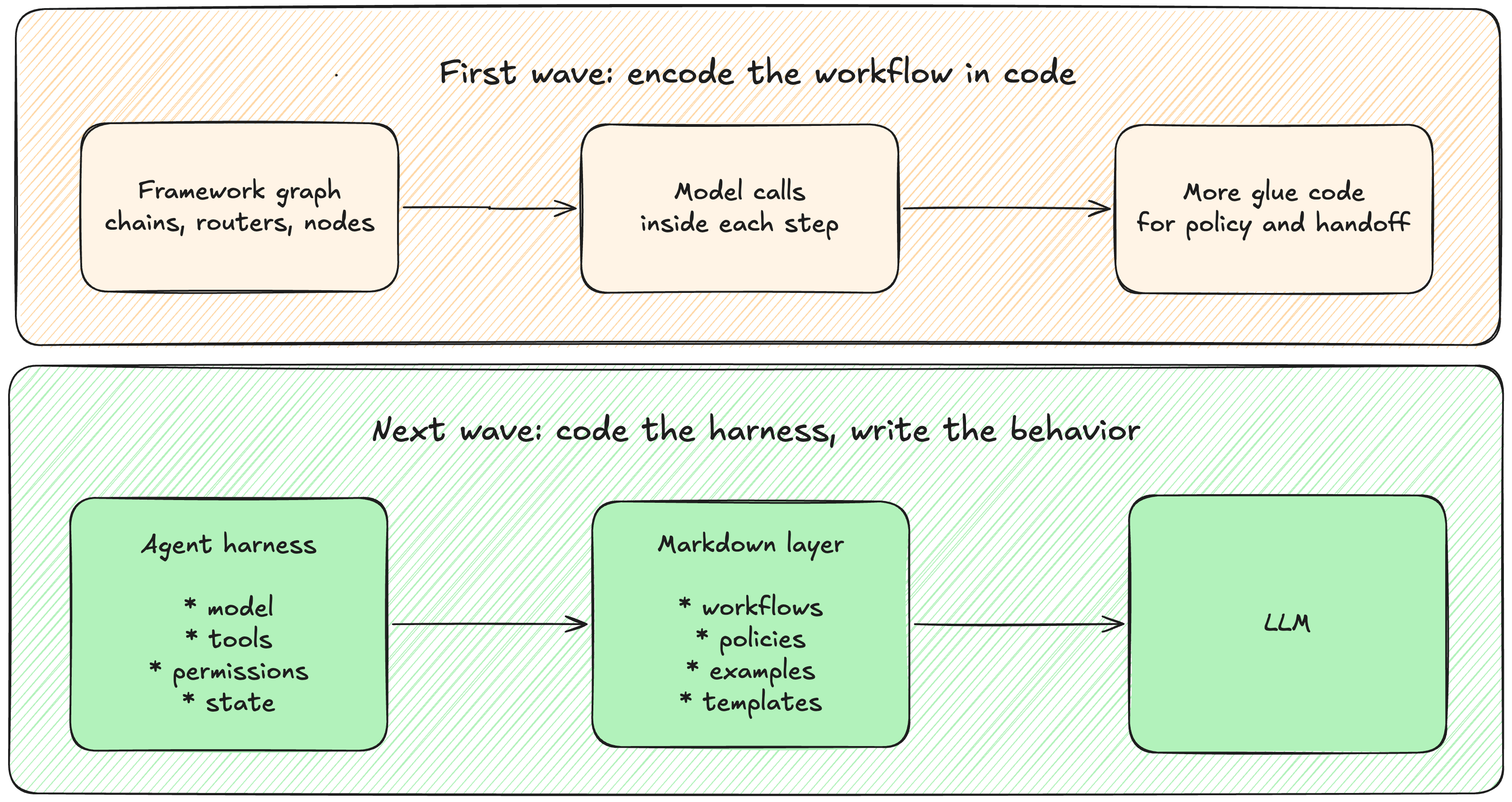
The First Version Was Too Much Code
The framework-heavy approach made sense at the beginning. Early AI applications needed scaffolding because the raw model interface was too loose. Retrieval needed structure. Tool calling needed wrappers. Production teams needed traces, retries, typed inputs, fallbacks, and evaluation hooks. LangChain and LlamaIndex became natural choices because they gave engineers a way to turn an uncertain model interaction into something that looked more like software.
I do not want to turn those frameworks into cartoon villains. They are useful libraries. LangChain has real orchestration and integration machinery. LlamaIndex is useful for indexing, parsing, retrieval, and data-connected applications. Both ecosystems support Markdown as an input format, whether through LangChain’s UnstructuredMarkdownLoader or LlamaIndex’s Markdown node parsers.
The problem is not that these tools exist. The problem is the reflex they encouraged: when an AI workflow becomes important, encode the next decision as another node. That works when the workflow is stable and the branches are genuinely software branches. It gets awkward when the workflow is really a written policy that people keep learning how to improve.
A support escalation rule should not always require a framework change. A source policy should not be buried in a callback. An editorial standard should not live as a prompt string in application code. A review checklist should not be scattered across several agent nodes. When those things live in code, the people closest to the domain lose the ability to improve them directly. The workflow becomes more formal, but not necessarily more maintainable.
This is how teams end up with an AI system that is technically sophisticated and operationally clumsy. The code can call the model, fetch the documents, route the task, and produce an answer. But changing what “good” means still requires spelunking through framework glue, prompt fragments, and hidden assumptions.
The Simpler Shape
The simpler architecture has three parts.
First, product code still owns capabilities and constraints. It defines the APIs, data access, permissions, transactions, schemas, audit logs, deployment paths, and anything else that must be reliable even when the model is wrong.
Second, the agent harness gives the model a safe place to operate. The harness decides which tools exist, which files can be read, what state is available, how approvals work, how traces are captured, how evals run, and where the system should stop instead of guessing.
Third, Markdown carries the operating behavior. This is where the workflow lives: the source policy, the escalation rules, the examples, the templates, the product vocabulary, the review expectations, the domain caveats, and the handoff contract.
That split matters because it puts the right kind of change in the right kind of medium. If the change must be enforced, it belongs in code. If the change teaches the AI system how the team wants work done, Markdown is often a better place for it. It is easier to review, easier to diff, easier to search, and easier for domain owners to maintain with engineering guardrails around it.
This is not no-code. It is not “let the prompt handle it.” It is a different ownership model: engineers build the harness and enforce the boundaries; the Markdown layer describes the work the harness should perform.
What Moves From Code To Markdown
The useful way to think about the transition is not “which language are we using?” The useful question is “what kind of decision is this?”
Code should own the decisions that need deterministic enforcement: permissions, data writes, destructive actions, money movement, external side effects, compliance checks, schema validation, deployment, rollback, and anything where being merely persuasive is not good enough.
Markdown can own a different class of decisions: how to investigate a bug, how to write a release note, what sources count as reliable, when to escalate a customer issue, what a good support answer looks like, how to compare devices, how to produce an editorial brief, how to prepare a pull request handoff, or how to explain a product feature without overpromising.
Those second-order decisions are still important. In many AI products, they are the product. A customer assistant that follows the wrong escalation policy is not a small UX problem. A research agent that treats vendor claims as neutral evidence will produce bad work. A coding agent that writes a migration without the team’s review expectations is creating risk. But the way to improve those behaviors is not always another code path. Often it is a clearer workflow, a better example, a tighter source policy, or a more explicit handoff template.
That is why Markdown matters. It is the medium where those instructions can become part of the application without disappearing into framework glue.
Why This Is Happening Now
Vercel’s Eve is the cleanest public example of this direction. Eve describes itself as a filesystem-first framework for durable AI agents. A typical Eve agent has an agent/instructions.md file as the always-on prompt, optional Markdown skills that can be loaded on demand, typed tools, channels, and schedules. The important thing is the authoring surface: the workflow is not primarily a visual graph or a chain of Python objects. It is a filesystem with Markdown instructions and skills.
OpenAI and Anthropic are moving toward the same split from the harness side. The OpenAI Agents SDK gives applications primitives for agents, tools, handoffs, guardrails, sessions, tracing, and human approval. The Codex SDK lets applications control local Codex agents programmatically. Anthropic’s Claude Agent SDK exposes the agent loop, tools, permission model, session management, MCP support, hooks, subagents, and filesystem-based configuration that power Claude Code.
Those SDKs are not Markdown frameworks. That is not the point. The point is that the harness is becoming product infrastructure. Once a product has a capable harness, the next question is where the product-specific behavior should live. My bet is that a lot of it will live in Markdown.
The instruction file conventions are already normalizing. Codex reads AGENTS.md for project instructions. Claude Code uses CLAUDE.md for persistent project memory and can import AGENTS.md to avoid duplicated guidance. Google’s Open Knowledge Format draft describes knowledge bundles as directories of Markdown files with YAML frontmatter, meant to be readable by humans, parseable by agents, diffable in version control, and portable across tools.
These are not the same thing. AGENTS.md, CLAUDE.md, Eve’s instructions.md, llms.txt, OKF bundles, and framework document loaders all have different scopes and loading rules. But they point toward the same underlying shape: humans write structured text, agents use it as operating context, and the product changes when that text changes.
There is also research pushing in this direction. The March 2026 paper “Interpretable Context Methodology: Folder Structure as Agentic Architecture” argues that, for sequential workflows with human review, folder structure and Markdown prompts can replace some framework-level orchestration. I would not stretch that into a universal rule. Complex concurrent systems still need real orchestration. But the paper matches a pattern many teams will recognize: a lot of useful work is sequential, review-heavy, and easier to inspect when the process is visible in files.
What This Looks Like In Practice
My own content system has pushed me toward this view. The Long Commit has a private Markdown operating layer: root instructions, voice rules, research standards, workflow files, templates, source policies, and Notion handoff rules. One workflow follows the sources I care about and produces a daily brief. The brief is not the article. It is a prepared starting point: what happened, where the primary sources are, what might be worth reading, and where the evidence is weak.
Then I read the sources and write the piece myself.
The useful part is that I can improve the system by editing the Markdown layer. If the brief overweights vendor claims, I change the source policy. If the output starts sounding generic, I change the voice guide and add examples. If the handoff misses caveats, I update the template. I am not rebuilding an orchestration graph every time my editorial process gets sharper.
The same pattern applies outside writing. For a smart home site like motherhome.io, Markdown workflows can define how to research a new device, which sources matter, how to compare Matter support, and what claims need caveats before publication. For Auth0-related technical work, Markdown can hold SDK references, implementation patterns, documentation paths, and examples of correct integration. For home automation, Markdown can describe what actions are safe, which commands require approval, and what the agent should never infer.
The domains are different, but the architecture is the same: the harness provides capabilities; Markdown carries the domain behavior.
A project might look like this:
ai-app/
├── AGENTS.md                    # Root router and shared agent policy
├── CLAUDE.md                    # Compatibility shim: import AGENTS.md
├── agent/
│   ├── instructions.md           # Runtime-specific always-on prompt
│   ├── skills/
│   │   ├── support-triage.md      # Procedure loaded when needed
│   │   ├── research-brief.md
│   │   └── release-note.md
│   └── tools/                    # Code: typed capabilities and integrations
├── profile/
│   ├── product.md                # What the product is and who it serves
│   ├── domain.md                 # Vocabulary, assumptions, edge cases
│   └── voice.md                  # Tone, naming, UX copy, audience
├── workflows/
│   ├── bugfix.md                 # How this team investigates and fixes bugs
│   ├── content-update.md         # How content gets researched and edited
│   ├── customer-escalation.md     # When to escalate, pause, or ask
│   └── deploy.md                 # Deployment workflow and human gates
├── policies/
│   ├── source-policy.md          # What counts as evidence
│   ├── tool-boundaries.md        # Which actions are allowed or dangerous
│   └── data-handling.md          # Privacy, retention, customer data rules
├── templates/
│   ├── pr-description.md         # Output contract for PRs
│   ├── handoff.md                # Output contract for human review
│   └── decision-record.md
├── examples/
│   ├── good-output.md            # Local taste, with reasons
│   └── bad-output.md             # Failure modes to avoid
└── evals/
    ├── cases.md                  # Scenarios the AI layer must handle
    └── rubric.md                 # What good behavior means
The folder names are less important than the separation of concerns. AGENTS.md should be a router, not a dumping ground. It should tell the agent what kind of project this is, which workflows exist, when to load them, what actions require approval, and where the source of truth lives. If a vendor-specific file is required, make it a compatibility file. My preference is that AGENTS.md becomes the boring root standard, with CLAUDE.md or instructions.md pointing back to it when possible.
The workflows should encode judgment, not only steps. A useful workflow tells the agent when to research, what evidence counts, when to stop, what output shape to produce, and what review must happen before the work is treated as done. Templates turn those outputs into contracts. Examples give the system taste. Policies and evals make expectations inspectable.
That is the application layer I think many AI products are missing. They have models. They have tools. They have framework code. They do not yet have a maintainable place where the team’s judgment about the work can live.
The Part Teams Cannot Skip
Markdown can also make a weak process look official. A stale AGENTS.md is worse than no AGENTS.md if the agent trusts it. A source policy that says “use reliable sources” is not a source policy. A workflow file full of vague advice is not a workflow. A compatibility file that quietly diverges from the real instructions creates another source of truth. A prompt that asks the model not to do something dangerous is not a substitute for a permission boundary.
Instruction files do not automatically improve agent output either. The June 2026 paper “Toward Instructions-as-Code”studied 15,549 agentic pull requests across 148 projects and found mixed results after instruction files were added. Some projects improved; others worsened. That is exactly the kind of result I would expect. The presence of a Markdown file does not prove the team has designed a good AI layer. It only proves there is now a place where good or bad instructions can affect the system.
This is why engineering ownership matters. If a Markdown file changes how the AI product behaves, then changing that file is a product change. It should have owners. It should be reviewed. It should have examples. The important workflows should have eval cases. Stale instructions should be deleted. Vendor-specific files should not multiply into five slightly different policies because every tool wants its own filename.
The future I am arguing for is simpler, not looser. It has less orchestration code for things that should have been written procedure, and stronger code around the parts that need enforcement. It gives domain owners a real way to improve behavior without pretending that prose can replace permissions, tests, or production controls.
The transition from code to Markdown is not a retreat from engineering. It is engineering putting the right work in the right layer.
If I were leading an AI product team, I would ask one practical question before adding another framework node: is this a capability the system must enforce, or is this behavior the harness needs to understand? If it is enforcement, write code. If it is behavior, policy, examples, or handoff, start by designing the Markdown layer.
That is the architecture I would bet on: code for capabilities and constraints; Markdown for the operating behavior the harness can execute.